
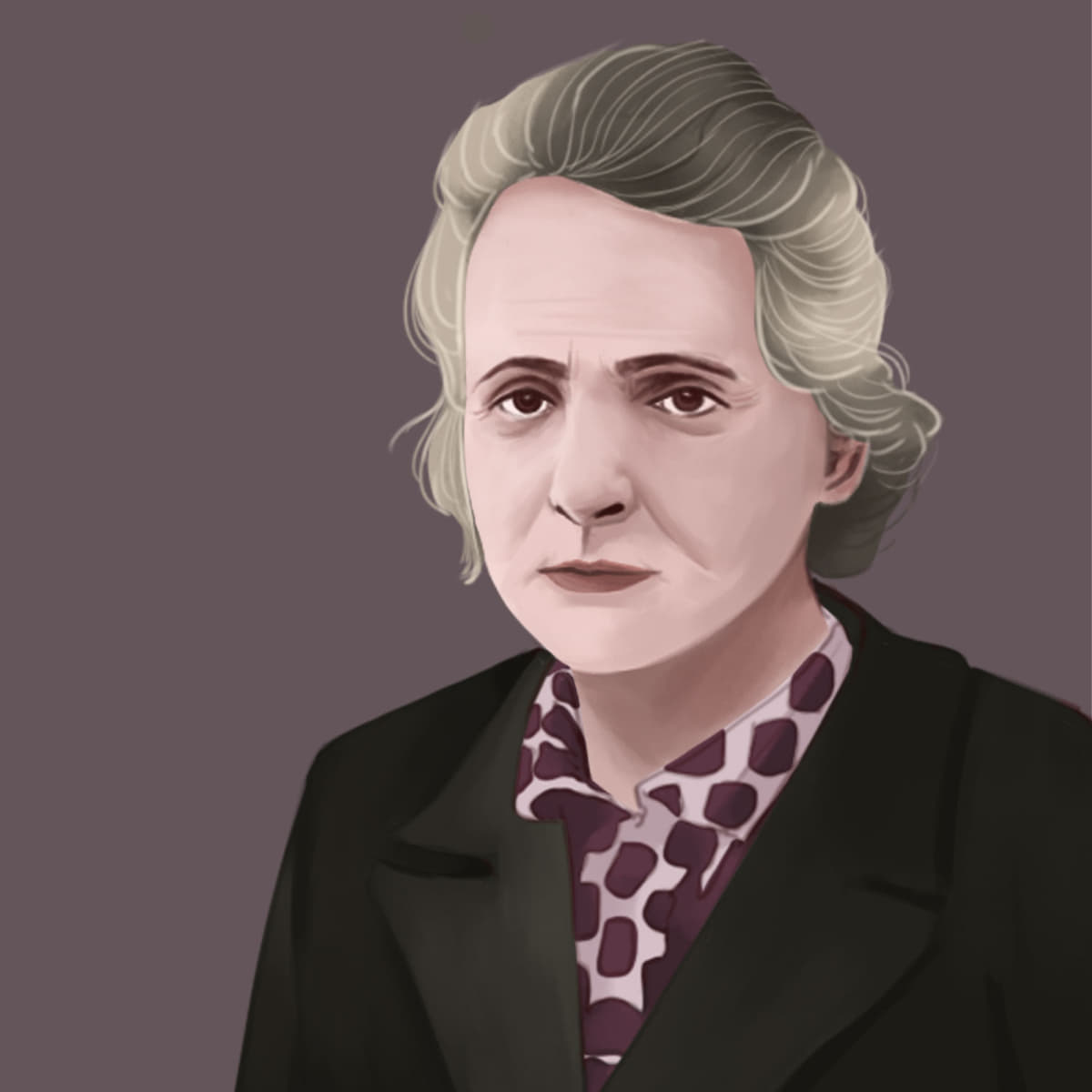
What are important facts about Madame Curie?
- Full name: Madame Marie Skłodowska-Curie, also known as Marie Curie.
- Birth and death: She was born on November 7, 1867, in Warsaw, Poland, and died on July 4, 1934, in Sancellemoz, France.
- Education: Curie attended the University of Paris, where she studied physics and mathematics.
- Achievements: She is renowned for her groundbreaking contributions to the field of radioactivity. Curie discovered two radioactive elements, polonium and radium, and developed techniques for isolating them. She also coined the term "radioactivity."
- Nobel Prizes: Curie became the first woman to win a Nobel Prize and the only person to win Nobel Prizes in two different scientific fields. She won the Nobel Prize in Physics in 1903 for her research on spontaneous radioactivity, and later the Nobel Prize in Chemistry in 1911 for her discovery of radium and polonium.
- Personal life: Marie Curie married Pierre Curie, a fellow scientist, in 1895. They had two daughters together, Irène Joliot-Curie and Ève Curie.
- Legacy: Her discoveries had significant implications not only in the field of science but also in medicine. The development of radiotherapy and its use in cancer treatment is attributed to her research.
- Contribution during World War I: Curie played a major role in providing mobile radiography units, popularly known as "petite Curies," to help diagnose and treat soldiers during the war. She personally drove and operated some of these vehicles.
- Nobel Prize controversy: After Pierre Curie's death, Marie Curie faced significant controversy and criticism. Rumors and scandalous articles were spread, highlighting her unconventional relationship with a fellow scientist, Paul Langevin.
- Legacy and recognition: Curie's contributions and courage in a male-dominated field continue to inspire aspiring scientists, particularly women. She remains as one of the most influential figures in the history of science.
Madame Curie book summary
Madame Curie is a biography written by the famous scientist Eve Curie, who happens to be the daughter of Marie and Pierre Curie. The book explores the life and achievements of Marie Curie, notably her groundbreaking research in radioactivity and her contributions to science.
The biography begins by delving into Marie Curie's childhood in Warsaw, Poland, where she faced many hardships due to her family's impoverished situation and the oppressive political climate. Despite these challenges, Marie showed tremendous resilience and dedication to her studies, eventually moving to Paris to pursue higher education.
In Paris, Marie meets Pierre Curie, a fellow scientist, and they soon embark on a remarkable partnership both in their personal and professional lives. Together, they conduct pioneering research on radioactivity, discovering two radioactive elements, polonium and radium. Their discoveries significantly impact the field of science and earn them the prestigious Nobel Prize in Physics in 1903.
Tragically, Pierre dies in a tragic accident, leaving Marie devastated and facing the challenges of continuing their work alone. Undeterred, she perseveres and becomes the first female professor at Sorbonne University, where she continues to make groundbreaking discoveries and advancements in the field of radioactivity.
The book also sheds light on the societal barriers Marie faced as a female scientist in a male-dominated field and the discrimination she experienced. Despite these obstacles, Marie's determination and sheer passion for science never wavered.
Madame Curie is not just a narrative of scientific achievements, but it is also a tale of personal triumph, love, and sacrifice. Eve Curie, through her unique perspective as a daughter, provides an intimate portrayal of her mother, painting a picture of Marie Curie as a brilliant scientist, devoted mother, and an inspiration to women around the world.
Overall, Madame Curie is a remarkable biography that tells the incredible story of Marie Curie's life, her profound contributions to science, and the lasting impact she has had on future generations of scientists.
Quotes of Madame Curie book
- "Nothing in life is to be feared, it is only to be understood. Now is the time to understand more, so that we may fear less."
- "Have no fear of perfection - you'll never reach it."
- "A scientist in his laboratory is not a mere technician: he is also a child confronting natural phenomena that impress him as though they were fairy tales."
- "I am one of those who think, like Nobel, that humanity will draw more good than evil from new discoveries."
- "There are sadistic scientists who hurry to hunt down errors instead of establishing the truth."
- "I was taught that the way of progress is neither swift nor easy."
- "I need to have something besides a husband and children to devote myself to! I don’t want to have lived in vain like most people. I want to be useful or bring enjoyment to all people, even those I’ve never met. I want to go on living even after my death!"
- "The greatest scientific achievement of the nineteenth century was the discovery of the relations of electricity to matter."
- "In science, we must be interested in things, not in persons."
- "There are sadistic scientists who hurry to hunt down errors instead of establishing the truth."