
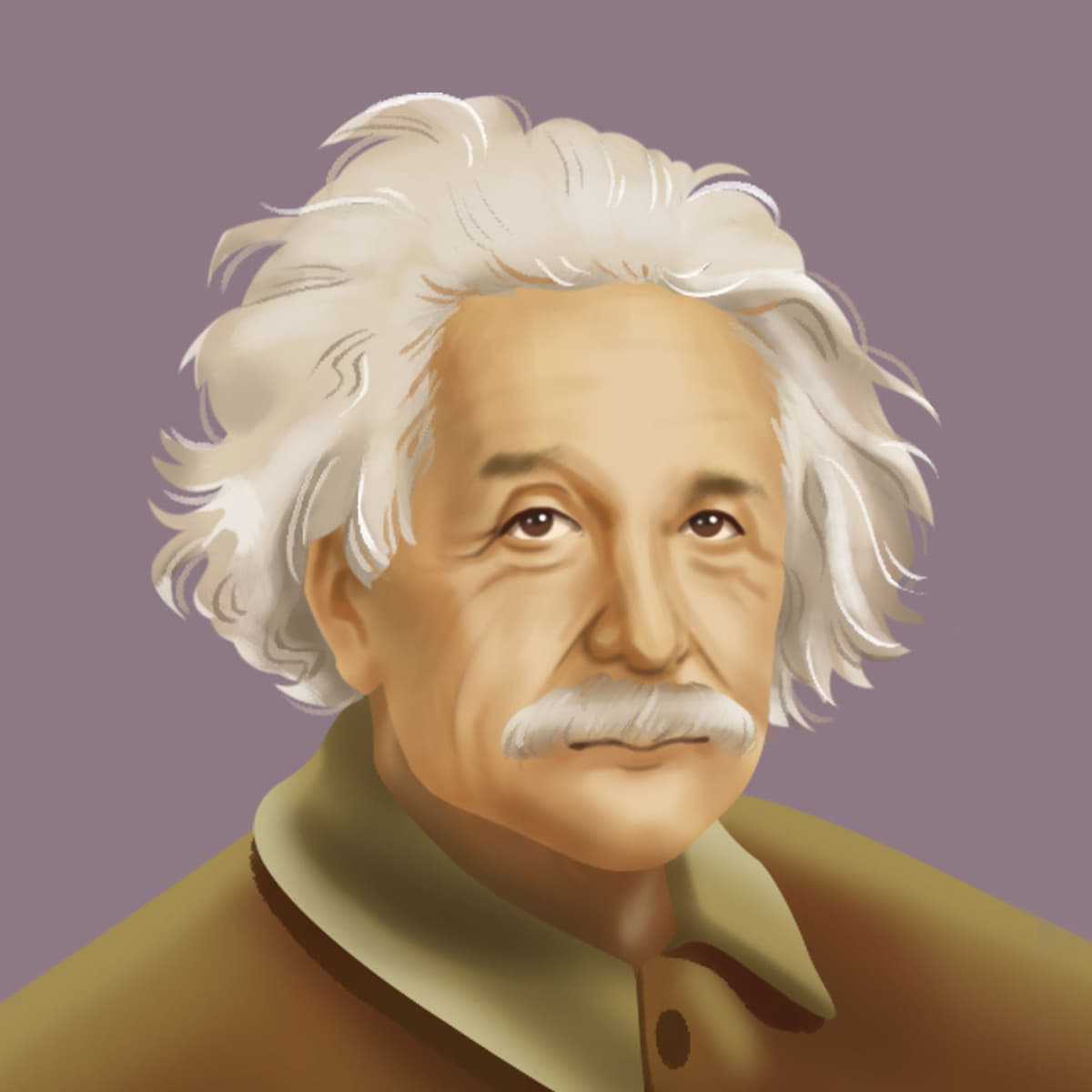
What is the full story of Einstein?
Albert Einstein was born on March 14, 1879, in Ulm, Württemberg, Germany. He grew up in Munich and showed an early interest in science and mathematics. However, his formal education was interrupted when his family moved to Italy due to financial difficulties. In 1895, Einstein attempted to gain admittance to the Swiss Federal Polytechnic in Zurich but initially failed the entrance exams.
Undeterred, Einstein studied at a Swiss cantonal school and improved his grades over the next year. He eventually gained admission to the polytechnic and graduated in 1900. Despite struggling to find a teaching position, Einstein continued to pursue scientific research and worked as a patent examiner at the Swiss Patent Office in Bern. It was during this time that he published his groundbreaking papers on the photoelectric effect and Brownian motion, solidifying his reputation as a brilliant physicist.
In 1905, Einstein published his special theory of relativity, revolutionizing the field of physics. This theory introduced concepts such as the constancy of the speed of light and the equivalence of energy and mass (E=mc²). It also challenged the classical Newtonian understanding of space and time.
Einstein's fame grew, and he accepted various academic positions, including a professorship at the University of Zurich and later at the Charles-Ferdinand University in Prague. In 1915, he completed his general theory of relativity, which described gravity as the curvature of spacetime. This theory was confirmed in 1919 during a solar eclipse, where the bending of light around the sun matched Einstein's predictions.
Throughout his life, Einstein continued to make significant contributions to physics, quantum mechanics, and his unified field theory. He received the 1921 Nobel Prize in Physics for his discovery of the law of the photoelectric effect, which laid the foundation for the development of quantum theory.
In addition to his scientific achievements, Einstein also became a prominent public figure, advocating for pacifism, civil rights, and Zionism. As the Nazi party rose to power in Germany, Einstein, who was Jewish, emigrated to the United States in 1933. He accepted a position at the Institute for Advanced Study in Princeton, New Jersey, where he spent the remainder of his career.
After World War II, Einstein dedicated himself to the pursuit of a unified field theory, seeking to reconcile general relativity and electromagnetism. However, he was unable to achieve this goal before his death on April 18, 1955.
Albert Einstein's contributions to science and his lasting legacy as one of the greatest scientific minds of all time continue to inspire and influence countless scientists and researchers to this day.
What is Einstein's biggest discovery?
Albert Einstein's biggest and most influential discovery was his theory of relativity. He developed two theories of relativity: the special theory and the general theory.
The special theory of relativity, published in 1905, revolutionized our understanding of space and time. It introduced the concept that the laws of physics are the same in all inertial reference frames, and that the speed of light in vacuum is constant for all observers. Special relativity also introduced the famous equation E=mc^2, which equates energy (E) with mass (m) and the speed of light multiplied by itself (c^2). This equation showed that mass and energy are interchangeable and laid the foundation for nuclear energy.
The general theory of relativity, published in 1915, extended Einstein's ideas to include gravity. It provided a deeper understanding of the nature of space, time, and the force of gravity. According to this theory, massive objects like planets and stars cause spacetime to curve, and this curvature influences the motion of other objects. The theory also predicted the existence of black holes and the expansion of the universe.
Einstein's theory of relativity had a profound impact on various fields of science and led to numerous technological advancements. It influenced the development of modern physics, including quantum mechanics, cosmology, astrophysics, and the understanding of the structure and behavior of the universe. Additionally, it played a crucial role in the development of nuclear power and the creation of atomic bombs. Overall, Einstein's theory of relativity is considered one of the most important scientific breakthroughs in history.
What important thing is to never stop questioning Einstein?
Albert Einstein famously once said, "The important thing is not to stop questioning." This statement encapsulates his philosophy of curiosity, inquiry, and the continuous search for knowledge. Einstein firmly believed that asking questions and challenging accepted beliefs and assumptions was crucial for intellectual growth and scientific advancement.
Einstein himself was known for his relentless pursuit of understanding the mysteries of the universe. His groundbreaking theories, such as the theory of relativity, were the result of his incessant questioning of the fundamental laws that govern physical phenomena.
By encouraging others to never stop questioning, Einstein emphasized the importance of critical thinking, innovation, and progress. He believed that curiosity was the driving force behind all scientific and intellectual achievements. Einstein advocated for a healthy skepticism towards established conventions, as he believed that it was through questioning and challenging assumptions that true breakthroughs could be made.
In essence, Einstein's message was that the search for knowledge is a never-ending journey. It is only by continuously questioning and exploring that we can hope to uncover the mysteries of the universe and push the boundaries of human understanding.